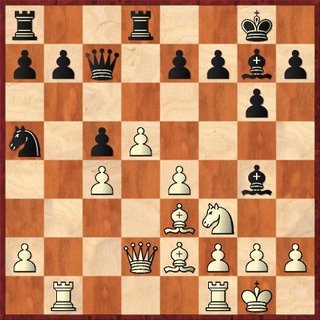
Brave Bishop
I recently finished one of the cleanest games of chess I've ever orchestrated, including what I think is a pretty cool bishop maneuver. I will be getting on to flogging myself over losses soon enough, but first, something to smile about.
The game started out as an awkward Sicilian,
1. e4 c5 2. Bc4!?This is supposed to be one of white's worst choices here. In fact, it's not even covered in my book on the Sicilian that covers 5 other "rare second moves". Instead of playing a solid refutation (2. ... e6) I just continued with normal accelerated dragon moves.
2. ... Nf6 3. c3I don't know if this is some kind of delayed Alapin or what but I decide I should be trying to play d5 so
4. ... e6 5. f4?! d5.
White is playing a mix of early Bc4, Alapin, and Grand Prix which seems uncoordinated to me. c3 is supposed to support a d4 push, which doesn't go well with f4 because it leaves a big hole on e4. I have the feeling black has already equalized.
6. exd5 exd5 7. Qe2+White gets a check in:
Black to move

White's pawn structure isn't good for development
6. ... Be7 7. Bb5 Nf6Black just develops his pieces. It's easier to know where to put the knight than the c8 bishop.
8. Nf3 0-0 9. Bxc6 bxc6 10. 0-0This is a critical position
Black to move

White might get away with playing d3, Be3, and Nbd2 and his position might not suck. This would be bad, we would like black's position to suffer more than if we simply allow these moves. A natural move here is just Bg4 because it feels nice to develop a piece with a pin, but this doesn't really do anything and perhaps the bishop might be better going to a6.
Instead, black finds a move that accomplishes two things.
10. ... c4!The exclam might be excessive, but lets see what we've got. First, we're holding back white's easy development since it's not as simple to move the d-pawn any more. Second, we're clearing the c5 square for our dark squared bishop that was in danger of not getting active. We do cut off the a6-f1 diagonal from our light squared bishop, but that bishop can have scope on the other side of the board (f5, g4).
11. d4This sticks black with a decision. There is only one chance to capture this pawn. There is some temptation to leave the pawns on f4 and d4 when white has a bad bishop. But the closed position doesn't bode well for black's bishop pair. Black would prefer to open up the vulnerable a7-g1 diagonal.
11. ... cxd3ep 12. Qxd3If you can see all the tactics from this position, give yourself a gold star
Black to move

Black needs to strike while the iron is hot. White is threatening to just play Be3 and Nbd2. It's still not the prettiest position for white, but it seems to hold together.
12. ... Qb6+Better than Bc5+ which can be met by Be3 or Kh1. Now Be3 hangs the b-pawn and there may be even worse consequences if 13. Be3 Ba6! Thankfully black doesn't have to calculate that line unless black actually makes the mistake Be3 and then it's just a matter of choosing the winning line he's more sure of. Kh1 loses material to Ba6.
13. Qe3 Bc5 14. Nd4 Re8White's moves are pretty much forced. After loading up on the weak diagonal, black goes to work on the open file and the exposed queen. Black doesn't want to lose a pawn on d4 so:
15. Qd2 Ne4 A great post of the knight with tempo.
16. Qd1Black to move

Black's pieces have gone forward while white's have not. Black can be proud of his better placed pieces, but this is not the moment to let up. Black might be tempted to play Ba6 to develop with tempo, but there is a better option for this brave bishop in this position. The c8 bishop enters the game in the most forceful way
16. ... Bg4!!This move is brought to you by the letter "f" and the number "2". This hint is probably enough to figure out why 17. Qxg4? is an immediate loser. So once again white is making an unhappy move with his queen instead of developing his pieces. White still doesn't want to hang a pawn on d4 and so chooses:
17. Qd3 And now black demonstrates why the previous move gets two exclams
17. ... Be2! This move forks the queen and rook, so black will certainly pick up material if white declines the bishop a second time, so how does black pull it out when the bishop is accepted?
18. Qxe2 Nxc3White to move

This move simultaneously captures a pawn, attacks the queen, and removes a defender of the d4 knight. If white tries to save the queen, black will recoup the sacrificed piece by taking the knight on d4 with check and still retain the extra pawn he's just captured on c3. Black does need to be certain that white can't get too much material for the queen. For example, 19. Nxc3 Rxe2 20. Nxe2 puts the material at a rook and two pieces for a queen and pawn, but the position is not yet quiescent and black regains one of the pieces with 20. ... Bxd4. In the game, white tried:
19. Qxe8 Rxe8 20. Nxc3Trying to protect the d4 knight with 20. bxc3 loses more material to 20. ... Bxd4+ 21. cxd4 Qxd4+ 22. Kh1 Qxa1 picking up the rook.
20. ... Bxd4+ and white has a Queen and pawn for Rook and knight, a winning material advantage.
The rest of the game is more technical in converting the advantage.
21. Kh1 Bxc3 22. bxc3 Re2 White has no real development and black is invading on the 7th
White to move
 23. Ba3 Qa6
This is an interesting move. White has to be prepared to meet Re1. In the game I decided I was willing to give back material in order to reach a winning King and Pawn endgame.
24. Rae1 Rxe1 25. Rxe1 Qxa3 26 Re8+ Qf8 White resigns.Maybe a bit early, but black retains the extra pawn going into the King and Pawn ending. This ending is not difficult to play.
Labels: diagrams, full game, tactics
Tactical melee
A recently finished game on chess.com was a real tactical melee for much of the game. Here is a position with the final tactical mistake:
White to move

Black has just moved Ncd4. On the face of it, the knights look like they are charging into white's position and positionally, black seems to be doing well. In reality this move just blew black's position and he is simply lost at this point. The whole game, including the winning continutation from this point can be seen at
chess.com.Labels: diagrams, full game, tactics
Tough losses
I had some tough losses at the coffeehouse this week.
In the first game I played against the Benko gambit. I don't typically have a lot of success against this opening, but I think I came out of the opening just fine. I've posted the full game in the analysis forum at chess.com,
here, feel free to comment on the game here or there. I've also posted
the game at chesslog just in case.
Labels: full game
My loss to the Budapest
One of my games at the coffeehouse last weekend was against the Budapest. This is a gambit for black that starts
1. d4 Nf6 2. c4 e5 3. dxe5 Ng4. I don't like letting black have all the initiative, so I play a line that gives the pawn back. I have a feeling I'll be seeing the Budapest on a regular basis from this opponent, so if anyone has comments on any line of the Budapest, I'd be happy to hear it.
I posted the whole game at
chesslog. I'll say a little more about two positions here.
After the opening moves,
4. Bf4 Nc6 5. Nf3 Bb4+ 6. Nbd2 Qe7 7. a3 Ngxe5 8. Nxe5 Nxe5 9. e3 Bxd2+ 10. Qxd2 O-O 11. Be2 d6 12. O-O b6White to move

Black has just played b6, no doubt to put his bishop on the long diagonal. I tried for a while to calculate something that would take advantage of the open diagonal before the bishop develops. The immediate Qd5 is met by c6. Bxe5 Qxe5 Bf3 doesn't get anywhere after Rb8.
Instead I settled on trying for a kind of minority attack. If I can break down the queenside pawns, black will be saddled with a weak, attackable structure. The game continued
13. b4 Bb7 14. Rab1 Rad8 15. Qc3 Qf6 16. Bxe5 dxe5 17. c5 h5 18. b5White to move

I'm keeping with my plan of breaking down the queenside pawns. Unfortunately, I've underestimated the attacking that's coming on my king. I also misplay the defense pretty badly.
18. ... bxc5 19. Qxc5 Qg6 Black lets his third pawn hang without protection, it's as if my plans are working. Until,
20. f3 Rd2 21. Qc4?? This should have been immediately punished by Bd5. Black still won with
21. ... e4 22. f4 Bd5 23. Qc5 Rxe2 24. g3 Be6 25. f5 Qg5 0-1It's important to take care of your house before you steal from your neighbors garden.
Labels: coffeehouse, diagrams, full game, tactics
Tournament Report
Black to move

Overall I was disappointed with the tournament experience. The way the sections broke I was the top seed in my section. I would have really loved to play some higher rated players, it's a much better way to put yourself to the test and find weaknesses in your game. I am happy that I was able to take care of business and win all my games. There are places where I didn't play perfectly, so hopefully I can learn from those.
Rating change: 1707 --> 1729
Labels: diagrams, full game, tactics, tournament
2 games from the weekend
This weekend I played a 3 round match between a few local clubs. I've posted my games with full annotations from the 2nd and 3rd round at
www.chesslog.de/users/loomis, the exact links are:
www.chesslog.de/users/loomis/?game=637 and
www.chesslog.de/users/loomis/?game=627. Hopefully there are things to be learned from those games.
The second round game features poor play by me culminating in my opponent making a tactical mistake that hangs a piece. I almost win the piece but foul up the idea and then he hangs a rook in time pressure. This game is another example that you don't have to have a positional advantage to have a winning tactic. At least not at the 1700-1900 level.
In the third round game I unsoundly sacked a piece but my opponent didn't properly refute the idea. At the end of the game I took a perpetual when I had a winning tactic on the board. It's kind of a long tactic, but the beginning of the idea was pretty simple and I didn't even consider it. Oh well.
I've come across more errors in CT-Art, but I'll save the diagrams for a later post. I'm now pretty sure that I won't finish the 1209 problems by the end of the year. I just don't have time to keep up that pace -- at least not while doing other things like playing in tournaments and annotating my games. Here are my current CT-Art stats:
- level 10: 97% (110 problems)
- level 20: 92% (286 problems)
- level 30: 86% (221 problems)
- level 40: 85% (83 done, 121 to go)
- elo: 2243
That's 700 total problems done. Leaving 509 to do. In the last week I did 71 problems. If that is a maintainable pace, it will take me just over 7 weeks to fully finish. There are 6 weeks left in the year (minus vacation time). So I expect to finish within the first two weeks of the new year.
Labels: full game, progress report
Tournament Report: Moderate Success
In 4 games I had 1 win, 1 draw, and 2 losses. Everyone I played was 100 - 150 points higher rated than me, so this is not a terrible result. For my own ego, I'll show a position from the only game I won:
White to play
Opponent, 1805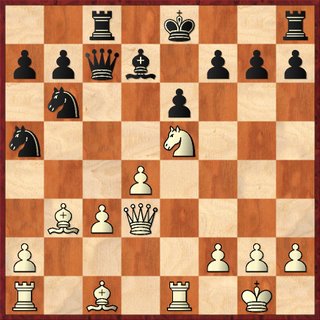 Loomis
The other games from the tournament are also posted at chesslog.de. They are games 537 through 540.
Overall I feel good about the tournament. Playing higher rated players and analyzing the games has shown me what some of my flaws are. Now I'll have to focus on correcting them. And of course, back to the tactics exercises!
Labels: diagrams, full game, tactics, tournament
Tournament Report: Doing better
I scored 1.5/3 at this weekend's tournament. But it was quite a confidence boosting 1.5.
In my first game I played a master rated 2290. He dubiously sacked a pawn in the opening and hung a pawn trying to get active play against my king in the middle game. Then he missed a tactic while trying to win back one of the pawns and I was able to win a queen for rook and bishop. So I was up a queen and pawn for rook and bishop. I was slowly making progress towards the win, but when my time got down to about a minute I started to play inaccurately and eventually hung enough material to just be losing. Here is the position where I get a real winning advantage:
White to Play
Master
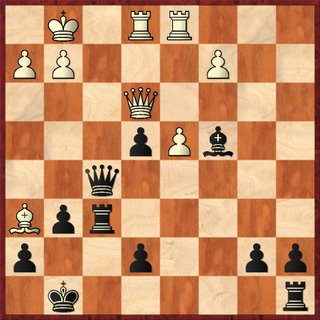 Loomis
Black has just played Rf8-f6. This move tactically defends the e-pawn. Can you find the continuation after Qxe4? I have posted the whole game at chesslog.de (
http://www.chesslog.de/users/loomis/?game=522) so you can see the solution there. That site is still a little buggy, but I believe the author is working on it -- It's a personal volunteer project, so we should just say "thanks" for what we can get.
In my second game I played a class B player rated about 1680. I felt like he didn't really understand the opening he played and allowed me to dominate the center without really trying to undermine it. He then helped me get a rapid kingside expansion and his position was soon overrun. I was surprised to win a game without feeling any real counter threats from someone of this rating, but I think it came more from his misunderstanding of the position than anything special I did. Eventually I'll put the whole game on chesslog.de, but for now, here are some key positions:
Black to Play
B-Player
Loomis
I have just played 14. c4 and my opponent replied 14. ... Bxf3. This move is also Fritz's first choice at a depth of 14, but I believe my opponent and Fritz are both misevaluating the position (Fritz evaluates it as = with a tiny edge to white, .25). There is the obvious tactic that the bishop is now guarding the c-pawn so I have recapture on f3 with the g-pawn. This results in doubled f-pawns and the open g-file leading to my king. Usually these positional factors would count against me, but here they shouldn't count at all because my control of the center means these weaknesses will never be attacked.
The game continued: 15. gxf3 b6 16. f4 Nc6 17. e5. All of these moves follow Fritz's top choice, but they are straightforward so this is not too surprising. Here is the current position:
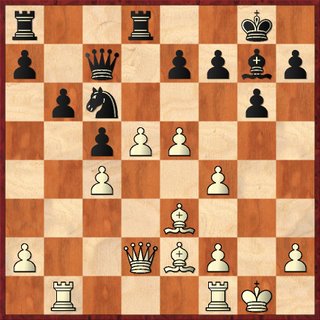
White clearly has a superior occupation of the center. The black knight and bishop still have their eyes on key squares and if he can shake up the pawns could break through, but I think white has a serious advantage here. On this move, though, I think black makes a real error: 17. ... g5. This attempt to undermine the white center backfires quickly in the game: 18. fxg5 Bxe5 19. f4 Bg7 20. f5 Be5 21. Bd3. This is one of those moves that I'm lucky to have available. The bishop simultaneously i) clears the queens path to defense of the h2 pawn, ii) unpins the d5 pawn creating a threat on the c6 knight, and iii) attacks the weak h7 square. Even at this time I am envisioning Bxh7 sacrifices.
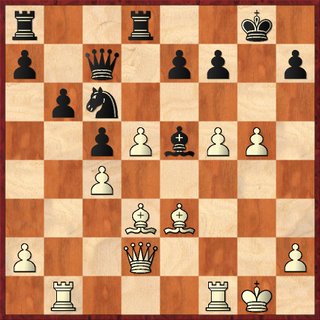 The position after the multipurpose Be2-d3. The continuation was 21. ... Nd4 22. f6 e6 23. Qg2! and now it's all over because the queen is going to the h-file. 23. ... exd5 24. Bxh7+ It turns out Qh3 was simpler, but I had this sacrifice on my brain for a while and calculated it all out. If Kxh7 then Qh3+ Kg8 Qh6 puts the king in a box (Ne6 is the only defense to immediate mate) and the g6 push is on the way. Black trusted me and without too much thought played 24. ... Kf8 and after 25. g6 he resigned. Final position: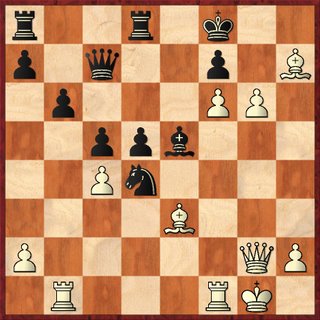
I don't want this description of this game to sound like too much braging, but this is as well as I've played in a long time, or possibly ever.
Rating change from tournament: 1683 -> 1702 (back over 1700!)
addition: I forgot to mention my third game which was a draw against an 1870. The only thing of note about this game is that at this point in the day I wasn't focused properly on the game. This is something I need to overcome. I played poorly out of the opening and was lucky to get a better position a few moves later. Not feeling able to focus on playing up to my ability I offered a draw which was acceptable.
Labels: diagrams, full game, tactics, tournament