CT-Art 765 Narrative
I'm once again delving into the narrative writing, and I've once again found an error in CT-Art in the problem set.
CT-Art 765:
White to move

White is attacking the king, but should be wary that his own king position is not perfect, the rook on f3 is pinned and the knight on c3 is attacked. At the moment, g7 and h7 are weak near black's king. The queen attacks at h7 adding a second attacker with g6 or Rh3 is not currently possible because these pieces are pinned. The bishop attacks g7, an attacker can be added with f6 and Qh6.
The immediate f6 suffers from the fact that opening the g-file gives some play to black. 1. f6 gxf6 2. gxf6 Rg8+ 3. Kh1 Qxf3+ 4. Rxf3 Bxf3#.
In order to play g6, white can sacrifice a bishop with
1. Bxg7 Kxg7 2. Qh6 Kh8 3. g6 fxg6 4. fxg6 White is threatening mate and CT-Art gives a poor defense for black, 4. ... Qc5+ 5. R1f2 Qg5+ forcing a trade of the queens, but giving up a defender of the f8 rook, 6. Qxg5 Bxg5 7. Rxf8. Instead, black can give up material temporarily with
White to move
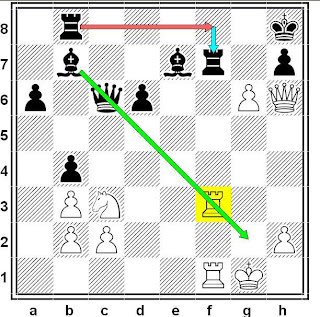 4. ... Rf7 5.gxf7 Rf8
 where black is getting his material back due to the pinned rook on f3. The idea is that if black wants to survive, he needs to keep his counterplay active, not trade queens.
If white wants real chances he needs to keep the lines to his king closed. A much simpler practical choice is
1. Qh5 with 2. g6 coming. 1. Qh5 bxc3 2. g6 and now even ... h6 fails to Qxh6, so black doesn't have time to take the knight on c3.
1. Qh5 f6 2. g6 h6 and now white sacs his bishop on h6,
3. Be3 with Bxh6 coming. In this way, white attacks the king position without opening dangerous lines to his own king.
Black to move

White attacks the black king, threatening Bxh6 without opening lines of attack for black.
Labels: CT-Art errors, diagrams, narrative, tactics
CT-Art 735
I was going to write a narrative on CT-Art 735 and decided to double check it on Fritz. It turns out the CT-Art solution has mistakes in multiple places.
CT-Art 735:
White to Move

The pawn on f7 is weak (only defended by king) and is the only defender of e6. In this kind of position, 1. Nxf7 Kxf7 2. Qxe6 immediately comes to mind as so many squares around the king can be controlled. 2. ... Kf8 is mated immediately by Bh6 so 2. ... Kg7 is forced. We can stay with forcing moves by 3. Bh6 Kh8 and now simply pry open the h-file with 4. Bxg6 where black loses quickly if 4. ... hxg6 5. Bf8+ Nh7 6. Rxh7+ Kxh7 7. Qf7+ Kh8 8. Qg7# (5. ... Nh5+ 6. Rxh5+ gxh5 7. Qh6+ Kg8 8. Qg7#). Other 4th moves for black give back excess material, e.g. 4. ... Rg8 5. Bf7.
The above is not the CT-Art solution. CT-Art starts off with 1. Nxf7 Kxf7 but then CT-Art gives 2. Rxh7. This is a good invading move, rooks are typically very well placed on the 7th rank:
Black to Move

The rook is immune from the knight, Nxh7 Qxe6 Kg7 Qxg6+ and mate follows with Bh6 or Qxh7. So black continues with 2. ... Kf8. Here CT-Art gives no credit for the very strong 3. Bxg6 instead favoring 3. Rh6 Bf8 (other moves may be better) 4. Rxg6 and then a serious error from the defense 4. ... Bg7? (Kh8 is more complex and doesn't lose nearly so quickly) which allows 5. Bh6 Nf4 6. Rxg7+ Qxg7 7. Bxf4 where white has three pawns for the exchange.
The CT-Art solution, while winning, is very complex compared to the first solution I gave. Even then, the solution given is helped along by inferior moves from the defense. A proper defense would have made this solution extremely difficult in practice.
Labels: CT-Art errors, diagrams, tactics
Level 20, rep 4
I finished level 20 rep 4. Significantly faster than last time through and at a higher percentage -- 98% (up from 92%, 94%, 95%). On to the real test of level 30, the real thorn in my side. I'm out of town Thursday to Monday which will slow me down a little. That's life, no wonder I can't do it the same as DLM.
Some concrete things I wrote down this time through:
-- Exercises 145 and 352 are the same
-- Exercises 217 and 228 are the same
Labels: CT-Art errors, progress report
CT-Art 267
It seems every time I go through the problems of CT-Art I come across new issues with the problem set. Problem 267 is a good problem, but happens to have a second solution to the one given.
Black to Move

The CT-Art solution is
e2 gxf3 h1=Q+ Kxh1 exd1=Q+. Unfortunately I calculated the line
h1=Q+ Kxh1 e2 where the knight can't stop the promotion. Here crafy plays
Nf2 and black gets a queen vs. knight where it's easy to mop up the pawns and win. In fact, in the CT-Art line, white can throw in Nf2 and have essentially the same ending.
Maybe I'll play the "correct" line next time through.
Labels: CT-Art errors, diagrams, tactics
Level 40
I'm working through level 40 on CT-Art.
There are a lot of subtle problems on this level and some of them have alternate solutions. For example, problem 707. The diagram comes a few moves in:
White to move

The solution given is Rb8. The simple threat is c7, the rook on b8 allows Nxc7 to be met by Bxc7 simultaneously defending the b8 rook. Black can also try Nxd8 c7 Ne6 Rxe8 Nxc7 and white can easily pick up the a pawn to be ahead an exchange and a pawn.
A fine way to win, but white can also play c7 immediately from the diagram. CT-Art gives c7 a "?" due to the response Nxc7! (The "!" is their's as well). These are odd markings because Rxc7+ Ke6 (to trap the bishop) Bxg5 hxg5 Ra7 leaves white up three clear pawns in the endgame. Despite what people say about rook endings being drawn, I had no problem converting this against the built in crafy engine.
Labels: CT-Art errors, diagrams, tactics
CT-Art coming apart at the seams
Ok, I'll say it. The makers of CT-Art did not put in the necessary effort to make problems at the highest difficulty they intended. They have flat out failed to make the problems on the last level correct. I'm not just blowing gas here either, I'll give you two very concrete examples -- and I promise the last levels are riddled with this kind of thing.
First, a simple example. A position from problem
1178.
White to move
White has crashed through on the kingside and just needs to polish off the mate. The first thing that came to mind was f7. This threatens mate on g8 and forces Bg7 (other bishop moves allow Qxh6). Then white will play Ne4 planning Nf6 or Ng5 threatening Qh7 or getting the queen to the h-file (e.g. Nf6 Bxf6 Qxh6 or Ng5 hxg5 Qh5).
With those ideas, we think, what if white plays Ne4 first. Black does not seem to have any real productive moves. Certainly not any more productive than he would play after Ne4 in the previous line. If you're really keen you'll realize that the move order with Ne4 first leaves the f7 square open for the knight, e.g. Ne4 c5 Ng5 threatening Nf7 (if hxg5 Qh5 leads to mate quickly).
The CT-Art solution was f7, with no credit for Ne4. The best line for black after f7 is Bg7 Ne4 c5 (CT-Art gave Rd5 falling for mate in 2) Nf6 (or Ng5) Be4 Nxe4 (Notice f7 is unavailable for the knight!) e5. White is ahead 2 pawns and has a much safer king, but the move order with Ne4 first was clearly better.
Ok, that was the simple example. At least the solution given by CT-Art was actually winning. Problem 1177 was riddled with even worse errors. This takes some time to explain the multitude of errors, feel free to skip to the end of the rant.
Black to move

The first move,
Bxh3, is difficult to calculate all the consequences of, but it's easy to see the white king position will be exposed and there will be chances for black. White's response
gxh3 is forced.

Now CT-Art completely misses the win. Qxh3 threatening Nf3 mate. Be2 is forced. Black then has
Nd5 and after white moves the queen away,
Qa3 Ng4 Bxg4 Qxg4+ Kh1 is forced.

Black continues,
Nxe3 fxe3 (forced)
Qh3+ Kg1 Qg3+ Kh1 Rd5 Threatening mate.
 White has to block the rook from going to h5 using either the knight or rook on f5. This gives a piece back to black after Rf5 Rxf5 Nxf5 Qh3+ Kg1 Qxf5. This leaves black ahead to pawns and the white king remains exposed.
This line starting with Qxh3 is not the solution given. Instead, the program gives what is actually a move that does not lead to an advantage. After Bxh3 gxh3 from the starting position, CT-Art gives Rxd4 Bxd4 Nf3+ Kg2 Nf5.
Position A, White to move

And now a poor move is played by white to allow black to win. CT-Art doesn't even consider Rfd1 which allows white all the wiggle room he needs to stay alive. The program gives Be3 as the main line. This allows N5h4 Kh1 Qf5 and the threat of Qxh3 is too strong.
The program also gives two other lines from 'Position A'. First, Bf6 gxf6 Rh1

And now the baffling Re8. There is no commentary or further moves after Re8 except that they give it an '!'.
The second line from 'Position A' is Rg1 N5xd4 Bd3 (another questionable move from white) Nxg1 (Qe5 was much better) Qxd4 Nxh3 Rh1 Qd5+ Qxd5 Nf4+ Kf3 Nxd5. After all that, black has a two pawn advantage.
Labels: CT-Art errors, diagrams, tactics
Tournament time!
After a very long time of not playing tournaments, I'm back! There is a tournament this Saturday and I'm very excited to be playing. We'll see if the tactical study overload can pay off in rating points. I should probably squeeze in some real games before I throw myself back in the fire. The time control is G/75 and the tournament is 3 rounds.
In other news, I have a glaring CT-Art mistake to share. In a handful of cases moves that are easily winning are 'wrong' because a somewhat better move exists (e.g. the difference between +2 and +3.5), but in this case, the program completely misses a mate in 2!
White to move
This is the starting position of problem 1082. The first move of the solution is Rd8+ and one variation given by Ct-Art is Kxd8 Qd2+ Bd4 Bxd4 Rc2 Bf6+ Ke8 leading to the position shown below.
White to move
And now the program gives Qxc2. Overlooking Rb8+ Rc8 Rxc8#. C'est la vie.
Current CT-Art stats:
Level 70: 72% (43 done, 16 to go)
CT-Art elo: 2452
Total done: 1082. Remaining: 127.
Labels: CT-Art errors, diagrams, tactics, tournament
CT-Art, level 30 finished
It's been a little longer than usual since I posted, I've had a shortage of time lately. In the meantime I have finished level 30 of CT-Art and begun level 40. I was disappointed in the number of mistakes near the end of level 30. I understand that when you put together over 1200 tactics problems there are bound to be a few oversights, what is really annoying is when I spend 15 minutes on a problem when I've found what is supposed to be the right answer and the refutation to it in the first 3-5 minutes.
Anyway, I'm going to post the problem numbers and diagrams here in the hopes that I won't waste time on these problems again in the future.
CT-Art problem 573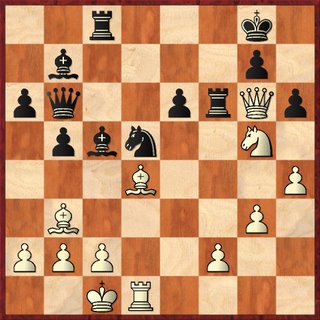
White to play. I played Bxf6 Nxf6 Nxe6, Nxe6 was rejected by CT-Art even though it is crushingly winning. The Ct-Art solution, Bxe6+, is also winning.
This position is from CT-Art problem 575.

The position is after Rg3xg5 Kxg5 Qg4+, the CT-Art solution continues with Kh7 and Bxf5+, there is no mention of the move Qg5 in the diagram position. This moves save the position for black. I saw all this from the beginning and wasted a lot of time trying to find an actual win, which there isn't.
This position comes from the first problem of level 40, number 618.
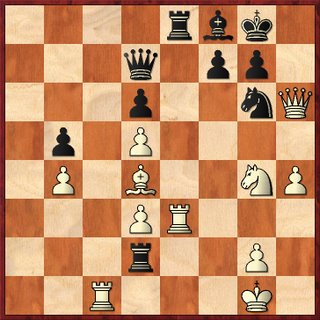
The CT-Art solution is Rxe8, planning to meet Qxe8 with Qxd2 and gxh6 with Nf6+. But there's no way to meet Rxg2+. So instead of Rxe8 I played Nf6+ because then gxf6 Rxe8 Rxg2 can be met by Kxg2.
Here are the current CT-Art stats:
- level 10: 97% (110 problems)
- level 20: 92% (286 problems)
- level 30: 86% (221 problems)
- level 40: 85% (12 done, 192 left)
- elo: 2168
In total I've done 629 problems, so 580 to go. I think it will be close as to whether I'll finish by the end of the year, but I'm keeping that as my goal.
Labels: CT-Art errors, diagrams, progress report, tactics
CT-Art, focus on the king
I'm pretty sure I'm learning from the CT-Art exercises, but they seem very artificial to me. I don't recall exactly, but it seems every problem is based on the king in some way, either checkmating or using checks to win material. In contrast, CTS problems are often just winning some material based on a tactic like a pin or fork without anything to do with the king.
The repeated theme of working against the king narrows the search enough that sometimes the problems are too easy. In some cases, the opponent has a mate threat so you know the answer has to be a check and there's only one check! Even if the check means sacrificing the queen, you can be sure it's right and then calculating the line is not so difficult.
Another problem I'm having is that it never marks problem 461 has having been solved. Despite the fact that I solved it the first time it came up and I've tried going back and solving it again. Anyone else ever have this difficulty?
CT-Art stats:
- level 10: 97% (110 problems)
- level 20: 92% (286 problems)
- level 30: 88% (144 done, 77 to go)
- elo: 2167
Labels: CT-Art errors, progress report
Ct-Art Exercise 252
I am through exercise 252 in CT-Art, stopping there because I spent far too long on that problem. The solution I calculated actually did win a piece or the exchange, but the correct solution won a queen for a rook. It's a little disappointing that the program doesn't count winning a piece as correct, but the requirement to be perfect will be good for getting better.
Here's the problem in question:
Black to move
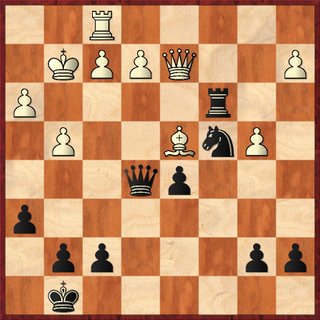
My solution was. 1. ... Qe4+, CT-Art gave 2. f3 as a refutation. My planned response to this move was 2. ... Nxd2 3. fxe4 Rc4 where I am attacking the rook and the bishop.
The better solution is 1. Rg3+ fxg3 2. Qe4+ and now black can take the queen free and clear.
CT-Art statistics:
- level 10: 97% (110 problems)
- level 20: 94% (142 problems)
- elo: 2031
It will probably take me through the end of next week to finish level 20. Tomorrow's regular weekly update will include some comments on this weeks work at CTS.
Labels: CT-Art errors, diagrams, progress report, tactics


