Ct-Art Level 50 done
I finished Level 50 of Ct-Art tonight. It's late, so I'm not going to write much, but I have also been doing tactics at some of the online tactics practice websites.
On
Chess Tactics Server I have started back doing some pretty regular tactics. CTS is useful for sight training. You see the motif and you play it. Or you don't see it and you sit there feeling foolish :-). Sometimes it takes me a while to solve the problem, but typically once you see the motif, the calculation is easy. So you really are training your sight -- see all the checks, captures, forks, pins, skewers, etc. and see them fast.
Another
chess tactics practice site is ChessTempo. Here the time contraints are not as strict as CTS and many of the problems require you to calculate quite a bit. So here you have to do more than see a single motif in the problem. These kinds of problems can be very frustrating, and I'm not certain that all of them are valuable learning tools, but I'm still giving it a chance for now.
Ct-Art at level 50 requires quite a bit of calculation. The variations are quite deep and while I admit I don't always see the full variation when I play the first move, I'm putting a ton of effort into calculating as deep as I can to get these right.
Here are the Ct-Art stats for all levels up to level 50:
Level 10: 97% (110 problems)
Level 20: 92% (286 problems)
Level 30: 86% (221 problems)
Level 40: 77% (204 problems)
Level 50: 76% (134 problems)
CT-Art elo: 2352
Total done: 955.
To go: 264.
Labels: chess tactics server, progress report
Tactics while tired
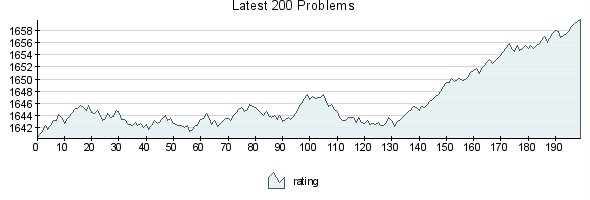
Today I had an interesting experience doing CTS tactics. I was doing problems there even though I was a bit tired. At the time I thought "Is this really affecting me?" and I honestly wasn't sure. After resting a bit, taking a nap, and refocusing, I did some more problems later in the day. Thanks to the reappearance of the ratings graph for the 200 most recent problems solved, I can show you the result:
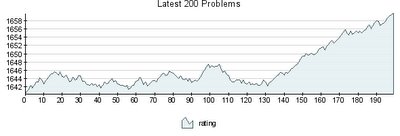
The bumpy region from 0 to about 135 that hovers between roughly 1642 and 1646 was my tired solving session. My post rest, refreshed, ready to go session starts between 130 and 140 and the rating takes off, getting to 1660 in about 65 problems.
I felt a clear difference when I started my second session. It felt like my eyes were far more active, moving more quickly and finding/seeing the pieces better. I don't know what this tells me about chess improvement, other than I probably wasn't learning anything while tired. Additionally, this indicates that tired is not a good condition to be playing in.
I'm heading out of town for the weekend, so there will be no Friday update, here are the current CT-Art stats:
- level 10: 97% (110 problems)
- level 20: 92% (286 problems)
- level 30: 87% (110 done, 111 to go)
- elo: 2149
Labels: chess tactics server, progress report
100 Done (level 30, CT-Art)
I just finished 100 problems in level 30. So I'm taking a break to read from my chess books. Here are the CT-Art stats so far:
- level 10: 97% (110 problems)
- level 20: 92% (286 problems)
- level 30: 86% (100 done, 121 remain)
- elo: 2138
As I predicted, the level 30 percentage has come down a bit. Some level 30 problems are simple, but most require a lot of calculation. There are some really clever tactics on this level. At least, it seems that way having never seen them. Hopefully once I learn them cold they will become simple as well.
I'm happy enough with my rate of solving so far. I'm hoping to finish the 1209 problems by the end of the year. I've done 496 problems so that leaves me 713 to do. I have a bout 9.5 weeks 'til the end of the year, but I'll be traveling this weekend as well as Thanksgiving (late November) and Christmas (end of December), so I probably need to stick with about 100 problems per week. In fact, it's probably best to do a little more than that while I'm still on the lower levels.
I've noticed quite a growing number of people, including even Temposchlucker now, who have decided to do CTS problems slowly. I think it's important to do tactics at all speeds. Lots of problems in rapid succession, tough problems requiring 1-5 minutes or sometimes more, and deep analysis of a single position (Stoyko exercise) or game annotation. For now I'll just say that I think CTS problems are best suited for the rapid succession category because of the way they are rated. I may say more about this later if I can muster enough energy to make my thoughts coherent.
My last tournament is now rated, just a minor rating change for me: 1702 -> 1707
Labels: chess tactics server, progress report
Friday Update
As usual, the weekly Friday update. Since I played in the 2-day tourney last weekend, I spent quite a bit of time analyzing and annotating my games. I did get back to the tactics training by the end of the week. At CTS my rating is now at 1641 after 16515 tries. That's about where it was last week. I don't mind the CTS rating holding steady while I delve into other chess activities. I do expect that I need to work on more ingrained pattern recognition in this department though.
In CT-Art I finished level 20 and have just begun level 30. Level 30 threw me for a loop at first, but once I started to focus better I began getting the problems with a healthy struggle. CT-Art stats:
- level 10: 97% (110 problems)
- level 20: 92% (286 problems)
- level 30: 93% (13 problems done, 208 to go)
- elo: 2076
I expect the numbers to decrease later in level 30 as the problems tend to get harder as the levels go on.
I have also done the first 10 problems from
The Reassess Your Chess Workbook. Silman gives a lot of text for the solution of each diagram along with a list of the important Imbalances and Ideas. While his biggest point is to make sure we understand the important characteristics, the solutions must necessarily involve playing the tactics correctly, so it's fairly well rounded.
I've read the introduction to Stean's
Simple Chess and I'm almost finished the section on Outposts. I'm not sure what impact this book will have on my game, so I'll reserve any judgements until much later. I do have high hopes for it.
Labels: books, chess tactics server, progress report
Friday Update
My rating at CTS took another down-turn this week. I am now rated 1640 after 16008 tries. The fact that my CTS rating has dropped each of the last two weeks coincides with starting the Ct-Art exercises. Of course, this may or may not be related. My first thought is that this indicates that CTS is a skill of its own that must be kept sharp. I would still like to see the CTS rating going up, as that indicates that I am solving more difficult problems, but it may go up more slowly if I am also focused on other chess things. That will have to be fine.
CT-Art statistics:
- level 10: 97% (110 problems)
- level 20: 92% (267 done, 19 to go)
- elo: 2061
I didn't finish level 20 by the end of this week as I thought I would. Many of the problems later in the level took quite a bit longer for me to solve. This is good news, I am happy to see that this problem set will be quite challenging for me. I did get close to finishing and should wrap up level 20 shortly.
The varied difficulty in level 20 makes me question the general intelligence of the folks at Convekta. I always thought it was silly that the levels were numbered 10, 20, 30, etc. What was wrong with 1, 2, 3? Now that I see there are 286 problems of varied difficulty in level 20, I think, couldn't they have broken this into levels 20, 21, 22, etc.? Well, I don't think it affects my chess improvement so I'm not worried, but it is a head scratcher.
I've started concurrently on Stean's Simple Chess and Silman's Reassess Your Chess Workbook. Basically fitting them in where I have time between tactics study. I'll try to write something more organized about this next week.
Tournament: 2-day tournament starts tomorrow!
Labels: chess tactics server, progress report
Friday update
Time for the weekly update. First, the CT-Art stats:
- level 10: 97% (110 problems)
- level 20: 92% (183 problems)
- elo: 2029
The level 20 percentage is already coming down. Most of level 20 is still relatively easy (a fair bit of mate in 2), but many are complicated enough to make me calculate. Given that the higher levels should be even tougher, it looks like this will be good for making me work hard. With another 103 problems left on level 20, I should finish in the middle of next week.
This week was a down week at Chess Tactics Server (CTS). I finished with a rating of 1650 (high 1672) after 15388 tries. At the end of last week and the beginning of this week when I made my high of 1672 I was focused on seeing all my pieces and their lines. This works very well for me, but unlike other things I have worked on, I can't seem to get it into a subconcious (auto) process.
Another thing I worked on this week at CTS is finding undefended or underdefended pieces. As the saying goes "Loose pieces drop off," so I figure if you can find the loose pieces, then it's just a matter of figuring out how to get them. A lot of times this is the order in which I recognize a pattern, first I see a weakness then I see how my pieces get to it. Unfortunately, to do this efficiently, I have to already know where my pieces are and where they can go. So I need to get both these things in my auto-process, but right now I seem to only do one at a time. I'm certainly not doing both efficiently.
Upcoming tournaments: One day, 3 rounds at G/75 tomorrow. Two day, 5 rounds, next week.
Labels: chess tactics server, progress report
Friday Update
I'm making it in time for Friday this week!
I'm still waiting on CT-Art and the books I ordered, so most of my chess time this week was spent on
Chess Tactics Server (CTS) and I am definitely getting better there. My rating is up to 1668 after 14096 tries (high of 1670). This is about a 50 point improvement since I started the Friday updates 8 weeks and 7000 tries ago and more than 110 points higher than when I first started at CTS.
Recently I have mostly been using CTS to work on seeing the whole board quickly and accurately. I want to be able to see each piece and where it can potentially go with a quick scan of the board. I noticed after trying this for a while that I was missing a lot of pawn moves. So I started to make sure that in my sweep of the board I paid attention to threatening pawn moves, especially pawns close to promotion.
I also spent some time with Baburin's book and I'm nearly done with chapter 7. That's the last chapter of section 1, so I'll move on to the other books when they arrive and I'm finished with chapter 7.
In other news, a tournament came on my radar for this weekend. It's just a 3 round one day event. I'm not sure what the time control is, I think it's something like G/60. This will be a good warm-up for the two day event I'll play in two weeks from now. It's also a good way to get in some longer serious games. Hopefully I'll have something interesting to say about these games next week.
Labels: books, chess tactics server, progress report
Weekend update
I'm a little late for Friday, so this week it's just the weekend update.
This week I mostly did problems at CTS and only a little bit from Baburin's book. One thing I worked on at CTS this week is making sure I look at every piece on the board. Sometimes I tend to get lazy in terms of viewing the whole board. A lot of the problems I fail on or take too long on, it's because there is a key piece I simply haven't even looked at. For example, a bishop moving on a long diagonal, or a rook that comes from the other side of the board. So I'm trying to make sure I am using the entire board.
After 13,383 tries, my CTS rating is 1651 with a high of 1653.
I also decided that I haven't been playing enough longer time control games, so I played a few this week. It's hard to tell if I'm playing better as a result of CTS training, but it seems like I am more aware tactically. I was a bit disappointed with my play in a few spots, but hopefully reviewing these mistakes will help me play better in the future.
I've ordered CT-Art and will start work on that problem set as soon as possible. CTS has been great for pattern recognition, but I feel like I need something to help me practice calculating. I've also ordered 3 books. Stean's
Simple Chess, Andy Soltis'
Pawn Structure Chess, and Jeremy Silman's
Reassess Your Chess Workbook. I think these should keep me busy for a little while.
Countdown to tournament time: 3 weeks!
Labels: chess tactics server, progress report
Friday Update
This week the regular Friday update is back on Friday. I'll spare the table this time because it just doesn't seem required. I only did a few challenges from Chess Mentor and only one of them was new, I continued reading Chapter 6 from
Winning Pawn Structures and I'm almost through that chapter. Most of my time was on
CTS.
I was interested to see what would happen after taking a full week off. Sure enough, my rating dropped fairly steadily from 1641 to about 1620. However, it only took another day or two for it to climb back into the 1640's and then to a new high of 1653. Overall I'm pleased with my progress on CTS, I'm definitely getting better at it (rating going up, % success is roughly 81% of late).
My rating there is currently 1646 after 11,826 tries. I've gained about 100 rating points in the last 10000 tries or 1 point per 100 tries. According to the problem distribution chart, increasing from 1540 to 1640 means the window of problems has increased by about 3000. That is, I am currently solving 3000 problems that I wasn't solving 10000 problems ago. I don't know if these ideas are meaningful to anybody who wonders about repetition and improvement, but it can't hurt to record them.
Personally, I don't think repetition is as important to improvement as active learning. By this I mean identifying and correcting ones weaknesses actively. Simply doing problems is not enough, one must use what they learn from their failures to motivate their work. I've given examples of this in the past (double attacks by the queen, especially checks; long diagonals) and I'll give a more recent one now. I noticed I had been having trouble with "Clearance" problems. That is, one move clears the path of a piece and the next move takes advantage of the increased scope. I had been working very hard on seeing everywhere pieces could go, but I realized I was only seeing where they could go
right now instead of seeing everywhere they
could go. This also has a cousin, but I'm not sure the name of it, I would call it relocation, it might be called triangulation -- what I mean is where a piece moves from one square to another on one move, then changes direction taking advantage of its new scope on the new square to go somewhere else on the next.
Once the weakness is identified, the process is to focus on never missing this idea in a position. E.g. if you don't want to miss double attacks by the queen, make sure you look at every possible queen move, especially checks and pay close attention to moves that attack undefended pieces. Continue to do this until you see these queen moves first before conciously doing the exercise. For working on clearance tactics, I extend the movement of all pieces beyond their obstacles to see if there are useful squares that could be reached after a clearance. Eventually I begin to see these ideas -- and how to achieve the clearance! -- before doing the entire concious exercise.
This is related to
Blue Devil Knight's post on eye movement. First, we must recognize which eye movements are not already part of our natural habits, e.g. queen checks, long diagonals, clearance, etc., then we must train our eyes until this eye movement becomes a natural reaction which Blue Devil compares to reading or recognizing a face -- you don't think about every letter or the details of someone's face, you recognize and understand. (Interestingly, when you read, you don't even think about the exact positions of all the letters in the word, see
this explanation.)
Lastly, I have a tournament in about a month, so I'm looking forward to that. Hopefully all this study will begin to pay off in the rating department!
Labels: chess tactics server, progress report
Friday progress
Well, I almost missed it and even though it's technically Saturday, I'll allow this as the Friday progress report. Front and center, here's the table of results:
| Week Ending | CTS
rating(max)-tries-%age | Chess Mentor | Book |
| Aug. 4th | 1600(1624)-7000-76.3% | 59 | Baburin, Chap 1 |
| Aug. 11th | 1614(1624)-7807-76.8% | 67 | Baburin, Chap 2 |
| Aug. 18th | 1615(1634)-8770-76.3% | 72 | Baburin, Chap 3 |
| Aug. 25th | 1623(1637)-9900-77.6% | 79 | Baburin, Chap 4+5 |
| Sep 1st | 1641(1651)-10798-78.0% | 80 | Baburin, Chap 6- |
Obviously that is a huge jump in my CTS rating. Several of the things I had been working on at CTS began to click. One thing I had been focused on was seeing the whole board. I have read in the past a study where they track the eyes of grandmasters and amateurs and found that amateurs focus their eyes on a portion of the board while grandmasters view all parts of the board nearly equally. I'm trying to view all of the board in just a few seconds, and it's getting easier. This has helped with some of my other weaknesses such as spotting long diagonal pins and finding open files for rooks.
Not much work done on Chess Mentor this week. Though it's deceptive because even though I did only one new challenge, I did several old challenges as repeats. I didn't finish the chapter from Baburin either (that's why the "-" in the table). It is one of the longer chapters, but that's a poor excuse. The other thing I did do was to actually play some chess games! I typically play a few blitz games (3 or 5 minutes) during the week, but I know that I have to play some slower games to practice what I am learning. So I played some slower games. I wasn't totally happy with how I played, but some things were good, I should probably post annotations here as a form of public flogging.
This week I'll be heading to the beach on vacation. I'm taking a book of checkmate exercizes (embarassingly named chessercizes) with me and will be doing mate in 4 problems while I lay out in the sand, or perhaps as I sip a daiquiri by the pool. Anyhow, my next post will be next Friday, which is only slightly less frequent than my usual rate.
Labels: chess tactics server, progress report
Remarkable endgame from CTS
Today I failed a problem on CTS and as a result spent some time analyzing an endgame. At first I was convinced that my move, while not as crushing as the actual solution, was easily winning. While trying to win the position against a computer program I nearly convinced myself it was a draw until I found a rather neat resource. Since I don't want to forget the position, I'm posting it here where there will be a record of it.
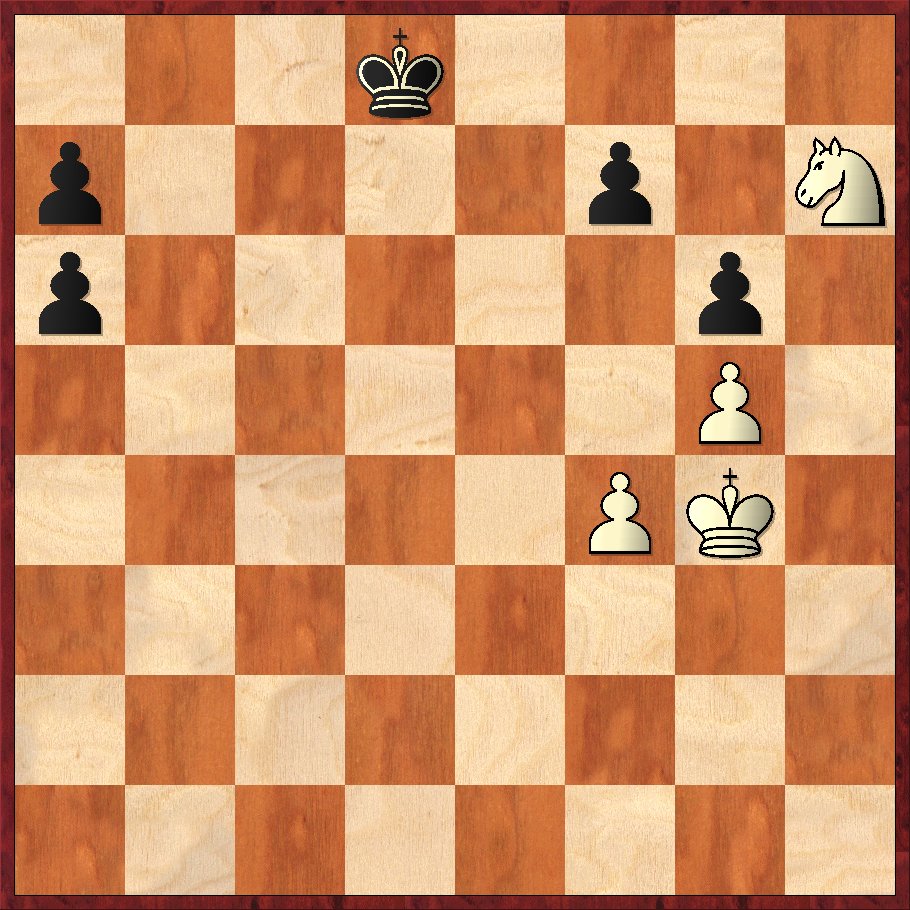
Here is the starting postition, white to play:

Now that your 3 seconds are over, the real solution is 1. Bd6! There are two important motifs here, the pinned rook on e7 and the mating attack if Rxd6.
The move I played was 1. Nh7+. This leads to 1. ... Ke8 (Kg8 Rxe7) 2. Rxe7+ Kxe7 3. Bf6+ Kd7 4. Bxd8 Kxd8 (D)

In my few seconds of thinking time during a CTS problem I was sure that this was winning. However, when I tried to play it out against the computer, I didn't manage more than a draw.
I kept hunting for the right way to play this and eventually found a cute resource for white. One of the main problems for white is that black can try to trade off the kingside pawns and leave white with no mating material. Black tries to bring the king to e6 and play f6 and g5. For example, if White starts out trying to reactivate his knight with 5. Nf6 Black will play 5. ... a5 and now the king is too far away so the knight must chase down the pawn and play might go like this: 6. Nd5 a4 7. Kf3 a3 8. Nc3 Kd7 and black will play f6 next. (Note that it doesn't help white to play 7. f5 trying to get his king over quicker.)
Another way for white to fail to win this position is to leave the knight on h7 to prevent the f6 push: 5. Kf3 a5 6. Ke3 a4 7. Kd4 Ke7 8. Kc4 Ke6 and now the black king penetrates to f5 and takes the f4 pawn.
So far we have learned that (a) if we use the knight to stop the a-pawn, the king will be too slow to prevent the black king from supporting the f6 push and (b) if we use the king to stop the a-pawn, the knight can not be contented to stop the f6 push sitting on h7 because the king will come to f5 and take the f4 pawn. But it turns out the knight can defend the kingside all by itself! So here is the solution:
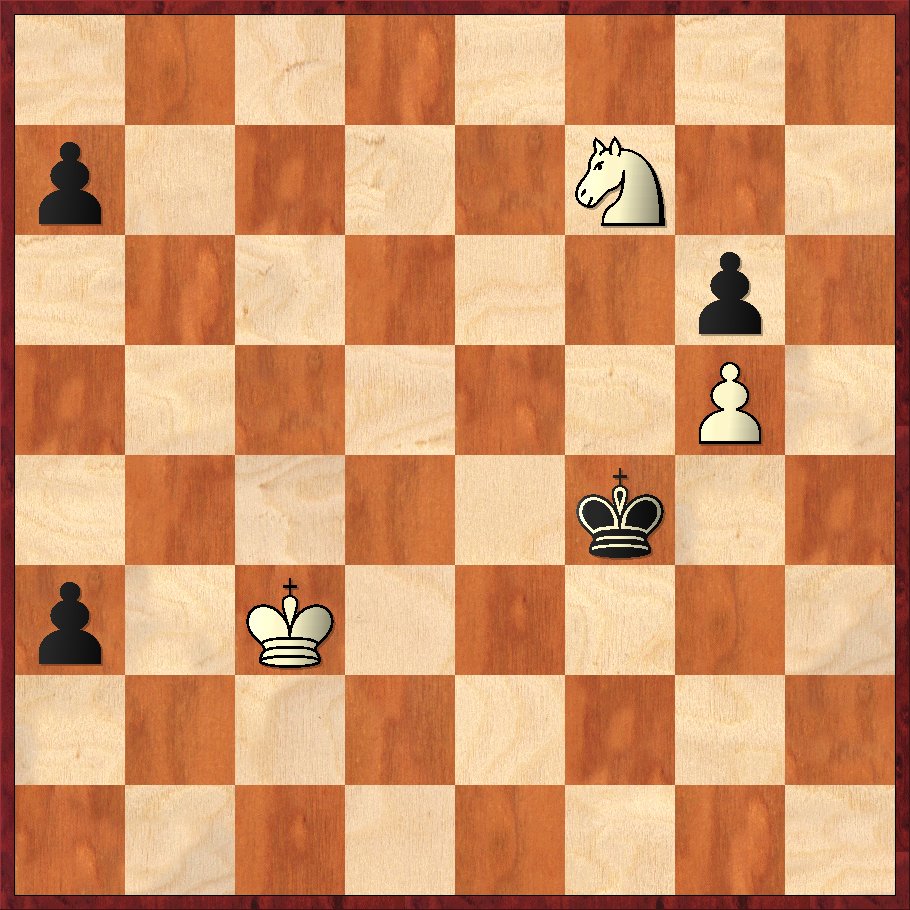
5. Kf3 a5 6. Ke3 a4 7. Kd4 Ke7 8. Nf6! Ke6 9. Ng4!! a3 10. Kc3 Kf5 11. Nh6+ Kxf4 12. Nxf7 (D)

The white knight now remarkably holds the g-pawn. If the black king tries to drive the white knight away, the knight will simply move to h6 causing a long trip for the black king to get back to the g-pawn. In the meanwhile, the white king is free to mop up the a-pawns before coming back to help on the kingside.
I doubt this endgame study will ever help me win a game, but at least it was entertaining!
Labels: chess tactics server, diagrams, endgame, tactics
Friday progress report
Friday is here again and that means an update on what I've been doing. I continued the same 3 methods I've been doing,
Chess Tactics Server,
Chess Mentor, and Baburin's
Winning Pawn Structures. Without further ado, here's the table:
| Week Ending | CTS
rating(max)-tries-%age | Chess Mentor | Book |
| Aug. 4th | 1600(1624)-7000-76.3% | 59 | Baburin, Chap 1 |
| Aug. 11th | 1614(1624)-7807-76.8% | 67 | Baburin, Chap 2 |
| Aug. 18th | 1615(1634)-8770-76.3% | 72 | Baburin, Chap 3 |
| Aug. 25th | 1623(1637)-9900-77.6% | 79 | Baburin, Chap 4+5 |
I managed to do 2 chapters in Baburin's book partly because they were shorter and partly because it was the first weekend I had in a month to work on chess. Two more chapters from that book will conclude the first section and then I will put it aside for a while.
At first I planned to to replace the book work from Baburin with Silman's Reassess Your Chess Workbook. However, after reading about Stean's Simple Chess on Blue Devil's blog, I decided to read a few more reviews and everyone raves about this book including more than one person in my rating class who attributes a lot of his recent success to reading and re-reading Stean's book. So, I've planned to read this book before Silman's.
I also have just one more week before I go, as Tempo would say, on holiday. Hopefully I will finish the first section of Baburin's book in that week. While I am away, I will take a book of checkmate problems with me to "stay in shape." It's a decent enough book for that purpose. It has mate in 2 through mate in 6 problems. I am currently on mate in 4. Once I get back from vacation I'll continue with CTS and start on CT-Art and Simple Chess. So now the plan is laid out for the near future and hopefully regular posting here will keep me on track.
Labels: books, chess tactics server, progress report
Chess Tactics Server Thoughts
I mentioned that I'd write about this a little while ago and I don't want to let myself down. I've been enjoying the
Chess Tactics Server (CTS) and my feeling via casual games I've played recently is that it is helping me see more tactics. The long term effects on my USCF rating are to be determined. When I started out at CTS a couple months ago my CTS rating was not much over 1500. I am now rated a bit over 1600 and so I believe that one can improve CTS performance through CTS study.
What is good at CTS
CTS is for learning quick pattern recognition. The time limits at CTS enforce recognizing the tactical patterns quickly in order to improve one's rating. It is not possible to calculate every possible move and response (computer search algorithm style) in order to determine the correct play under the time limit. Thus it is necessary to recognize the tactical patterns, see the moves and understand their consequences subconciously, and perhaps calculate only narrow forced trees.
When we get a problem wrong at CTS we must consider the source of error, otherwise we are doomed to this failure forever. Shortly after I began at CTS, I was missing or taking a long time on problems that were well within the scope of my chess understanding. In large part they were double attacks with the queen, most often checks. Why was I getting these problems wrong? I simply did not see the queen move when first presented the problem. Upon recognizing this, I made an effort to see all queen checks. Slowly I began to see all the queen checks without effort! This is pattern recognition.
As a second example, I also began to overlook defensive resources (the piece I want to move is pinned or my king is already in check!) for the opponent. Sometimes I would see a fork or skewer or something that appeared to win material and be stunned that my answer was wrong. I had overlooked a defensive resources thwarting my tactical idea. The correct tactic was first removing the defense or something else altogether! Thus I made a conscious effort to look for defensive resources for the opponent. Slowly I began to see defensive resources without much effort at all, and be more confident that there is no resource if I don't see one.
The fast time controls are important at CTS. They enforce the understanding of the solution without effort. Most of the problems that are just beyond my range in 3-10 seconds are still solvable with the right effort. It is important that I continue to put in this effort until they can be solved without it, only then should I move on. Thus, the time control ensures my rating will remain low enough that I will work on these problems until they are solved with less effort.
What CTS is not good for
CTS is not for calculation training. Calculation, as in a real game of chess, requires time. It requires considering many possibilities, some of which will include patterns like the ones learned at CTS. Thus, what is learned at CTS can aid in calucation, but it does not teach one to calculate.
CTS is not a game simulation. Every problem in CTS has a clear tactical resolution. I estimate that perhaps 10% of the time there is a clear tactical resolution during our move in a real chess game. The majority of the time, we are preparing our army to be ready for the tactical resolution. There will almost certainly come a time in our game where there exists a tactical blow, and certainly what we have learned at CTS will help us, but for the majority of the game, this is not as immediate as it is on the problems at CTS.
As always, we must have a balanced approach to learning chess. CTS alone cannot be enough. Studying deep tactical problems that require calcuation is necessary and studying positional ideas is necessary.
Rating and Percent Success
Some people are concerned with rating and percent success. My opinion is that in large part these things do not matter. Your CTS rating is not there for your ego. It exists so that the problem set you try to solve is taylored to your needs. It is not necessary to try to get a high rating, nor is it helpful to your chess playing ability. Your CTS rating will increase when your pattern recognition improves, presumably, so will your overall chess ability.
Of course we should strive to get a problem correct when it is put in front of us. Putting in this effort helps us learn the patterns. But we should not fear getting problems wrong. Often this most stern reprimand is the best way to open our eyes to our faults. Once our eyes are open, then we can work on the repairs.
Labels: chess tactics server
Progress report
I've decided that Fridays mean progress updates. In addition to just spitting out the numbers this week, I'd also like to organize my future plans a little. To that end I've first organized my current work in a table format:
| Week ending | CTS
rating(max)-tries-%age | Chess Mentor | Book |
Aug 4 | 1600(1624)-7000-76.3% | 59 |
Baburin, Chap 1 |
Aug 11 | 1614(1624)-7807-76.8% | 67 | Baburin, Chap 2 |
Aug 18 | 1615(1634)-8770-77.3% | 72 | Baburin, Chap 3 |
This table conveys what I've accomplished so far. My CTS rating, the number of challenges done in Chess Mentor and the book I'm currently working on, Baburin's "Winning Pawn Structures." The number of Chess Mentor challenges is deceptive because this week more than half of the challenges attempted were repeat challenges, so the number of new challenges didn't increase much.
While I think each of these things is benefitting me, I also think it will soon be time to shake things up a bit.
Sometimes in Chess Mentor I get a problem that I remember from a previous time. While I believe repitition is necessary for learning, I often score well because I remember the moves rather than having learned how to find them. I think I would benefit by putting CM aside and coming back to it later when my memories have faded.
Baburin's book is very well written and I think I learn a lot from his presentation. However, the book is somewhat narrow in focus. Every game presented involves the isolated d-pawn. Once I finish Part One on the advantages of the isolated d-pawn, I will put that book aside and come back to the second part later.
I am going to stick with Chess Tactics Server long term, so I just need to have something to replace CM and Baburin. Since I am always hearing so much about CT-Art, I've decided to try that. I don't know if I will do the 7 circles or not, I think it's best to see how quickly I work through the levels and make a decision then. To replace Baburin I am leaning toward Silman's Reassess your chess workbook. His book helped me improve quite a bit a few years back and working exercises in that style might be just what I need.
I plan to continue my current three methods through the end of August. I have a week vacation in the beginning of September and following that, I will make the switch to CT-Art and RYC-Workbook.
Labels: chess tactics server, progress report
Training progress
I'm headed out of town this weekend which means a mini-break from chess. Before I go, I just want to jot down my current training progress.
CTS:
- Rating: 1614 (current), 1624 (peak)
- Tries: 7807
- Success: 76.8%
Chess Mentor:
- Challenges with scores: 67
- Average of initial scores: 61
- Average of latest scores: 83
Winning Pawn Structures
- Chapters complete: "White advances d4-d5," "Attack on f7 (f2)"
- Upcoming: "Rook lift," "Bishop sacrifice," "h-pawn battering ram," etc.
No real thoughts in this post, I just want to make sure I'm keeping a written record of what I've been up to.
Labels: chess tactics server, progress report
Chess Tactics Server oddity
I recently came across something a little odd at
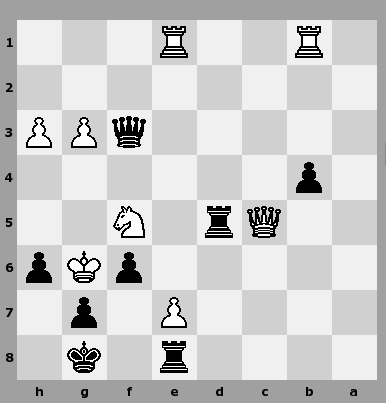
CTS. There are two problems there that are nearly identical, number 59505 and 06868 have the same starting position:
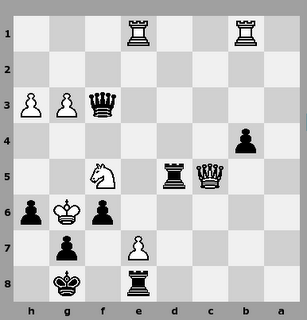
In one problem white plays Qc8 and in the other white plays Qc2, in each case defending the knight on f5. The solution to both problems is the same! You can take a minute to look at it, but here comes the answer: Qxg3+ Nxg3 Rg5#.
The problem with Qc2 is rated 1605 while the problem with Qc8 is rated 1679. Why is there a 70 point rating difference between essentially the same problem? One explanation is that on Qc8, the solver may immediately be attracted to Rxc8 and take time to realize that is incorrect before finding the correct solution; while on Qc2 the solver will have nothing to look for but checks on the king.
The less satisfying answer is that the rating system is flawed. While I do believe there are some problems at CTS where the rating system is not accurate, I hope it's not flawed here. The potential flaw is that the rating of a problem depends sensitively on which tacticians have attempted it and when. I have my fingers crossed and hope this isn't the case.
Labels: chess tactics server, diagrams, tactics
Tournament tomorrow and current progress
Tomorrow I will play in a one day tournament. Maybe playing two weekends in a row will be good for me. I sure need something to wash away the feeling from last weekend. Though I probably won't play another tournament until October, possibly at the end of September. I'll test out the idea of trying to at least list every legal move. The first two rounds are G/40 and the last two rounds are G/60, so I'm not sure how that will go with the short time controls. I may abondon it if I find myself in a large time deficit.
I thought I should also make a record of what I'm up to, so there is some progress to track. As I mentioned earlier, I do problems at
CTS and use
ChessMentor for more in depth (longer time, tactical + strategic ideas) problems. So I'll give my current stats for those.
CTS:
- Initial rating: ~1530 (Can't recall exactly, but I remember early on being psyched to get to 1550).
- Current rating: ~1600 (I am now over 1600 all the time with a high of 1624)
- Problems done: 7000
- Success rate: 76.3%
Chess Mentor:
- Challenges with scores: 59
- Average of initial scores: 61
- Average of latest scores: 79
Chess Mentor is a little odd because problems (challenges) that have only been done once have the same initial and latest scores. So the number of the latest scores doesn't fully measure the improvement due to repitition.
Additionally, I have started working through "Winning Pawn Structures" by Baburin. The book is mostly on the isolated d-pawn. The first section is on advantages of the isolated d-pawn. I have completed the first chapter, "White advances d4-d5." Following chapters are "Attack on f7", "the Rook lift," "Bishop sacrifices on h6," "h-pawn battering ram," "Queenside activity," and "Play on the e-file." I'll update my progress on these chapters as I go, and then the section on disadvantages of the isolated d-pawn.
The ratings are in from last weekends tournament: 1708 -> 1685. Maybe I can recoup some of those points tomorrow.
Labels: chess tactics server, progress report
Upcoming tournament
Currently the plan is to play in a tournament this weekend (2 days, 5 rounds). The tournament is about 1 hour from my home, so I'll be commuting and taking a bye in round 3 Saturday night (don't want to drive home so late). The big question for me is whether to play up a section. I have played in the U2000 section before; I don't feel totally outclassed there and it's a better learning experience than the U1800 section. On the other hand, there is nothing like the thrill of trying to compete to win your section, which is more likely in my "natural" U1800 section.
My recent study has mostly been a lot of problems at
CTS. I am definitely improving my instant recognition of patterns by solving problems there and I'm interested to see if this pays off in a long tournament game. The key with CTS is to understand what it is good for and what it isn't. CTS doesn't simulate game conditions, but it can help you to build a wealth of tactical vision on which to base calculations during a real game. I continue to play plenty of blitz games and while I've uncorked a few nice combinations recently, the USCF rating will always be a more accurate judge.
I also wrapped up reading John Nunn's "Secrets of Practical Chess" recently. It was a fairly straighforward read with lots of good advice. I'm not sure it will have any effect on my chess ability, but perhaps some of his ideas will have sunk into my subconscious.
My study also includes working through
Chess Mentor. This is an intersting piece of software that takes you move by move through the winning side of a partial game. At each step you have to try to find the right move and any wrong move you make comes with an explanation. There are times when these explanations aren't adequate to explain why the move is wrong, but nobody's perfect. A lot of the ideas presented are strategic or positional in nature and not just tactical. There is typically tactical motifs throughout the line, but it is a definite contrast to the kinds of positions on CTS, it simulates a real game more closely.
I own a few other books (winning pawn structures, Zurich 1953, instructive modern chess masterpieces, positional play), but I haven't really delved into them enough to call it studying. A couple years ago I tried with Positional Play (by Dvoretsky), but this book may have been too advanced for me. I've been through some of the games in Instrucive Modern Chess Masterpieces (Igor Stohl), but it never seems instructive to me in a practical sense. Zurich 1953 was recommended to me as one of the best compilations of master games to go over. I should probably dedicate a whole entry or more on why I struggle with going over master games.
Labels: books, chess tactics server